
 ru
ru

Vibecoding Is Trust. We've Been Doing It Since 1995.
Software engineers in 1995 were already vibecoding — they trusted their compiler to write machine code they never read. The dial of trust just turned from 80% to 95%.
I wrote earlier on why you won't lose your job to AI — you'll lose it to someone who learned to manage many agents. The follow-up question I keep getting is "but how can you trust the machine to write your code?" Wrong question, and let me show you why.
Programming has had three eras
In the 60s, you needed mathematical thinking and formal logic — your code was a thin skin over the math, and if you didn't know what was underneath, you couldn't write the skin.
In the 90s and 2000s, software engineering replaced programming and syntax took over: JavaScript, Python, Java. Most devs never opened a math book again, and most of them don't even know their language is a mathematical abstraction running on top of another mathematical abstraction running on top of silicon. They don't need to know — the compiler handles it, the stdlib handles it, the GC handles it, the CPU's branch predictor handles it.
The 2000s ran on trust, not syntax. Trust that the compiler compiles correctly, that the library does what its docs say, that the database saves what you wrote to it, that the framework you're using won't break tomorrow. The 90s dev was running at maybe 80% trust in the stack — up from 50% in the 60s, when the abstractions leaked everywhere and you had to know what was underneath. They just don't call it trust because it's been validated for decades and became invisible.
Now to vibecoding
Vibecoding doesn't introduce trust, it just turns the dial up — the muscle is the same, only the number is new, and it jumped fast enough that the muscle hasn't caught up yet.
The reason senior devs resist this isn't technical, it's identity. Their whole career was built on "I know things the machine doesn't," and vibecoding inverts that — the machine knows the syntax, the libraries, the patterns.
What's left for you is judgment, and that's a promotion, not the demotion many feel it to be nowadays.
The CTO doesn't write code, the architect doesn't write every line — they've always traded execution for judgment, and vibecoding just makes that job available a decade earlier in your career. You're not being deskilled, you're being moved up the ladder before you asked for the move.
Concrete picture: two people on the same team get the same Monday brief — build a small internal tool that lets sales filter leads by region. Anna opens her IDE and starts typing because she knows the framework and she's fast. Mike writes the spec — what the tool does, what it doesn't, edge cases, who's the user — hands it to Claude, ships Wednesday. Anna ships Friday, two days later. Multiply that delta across every ticket for the next six months and you understand what's happening to teams right now.
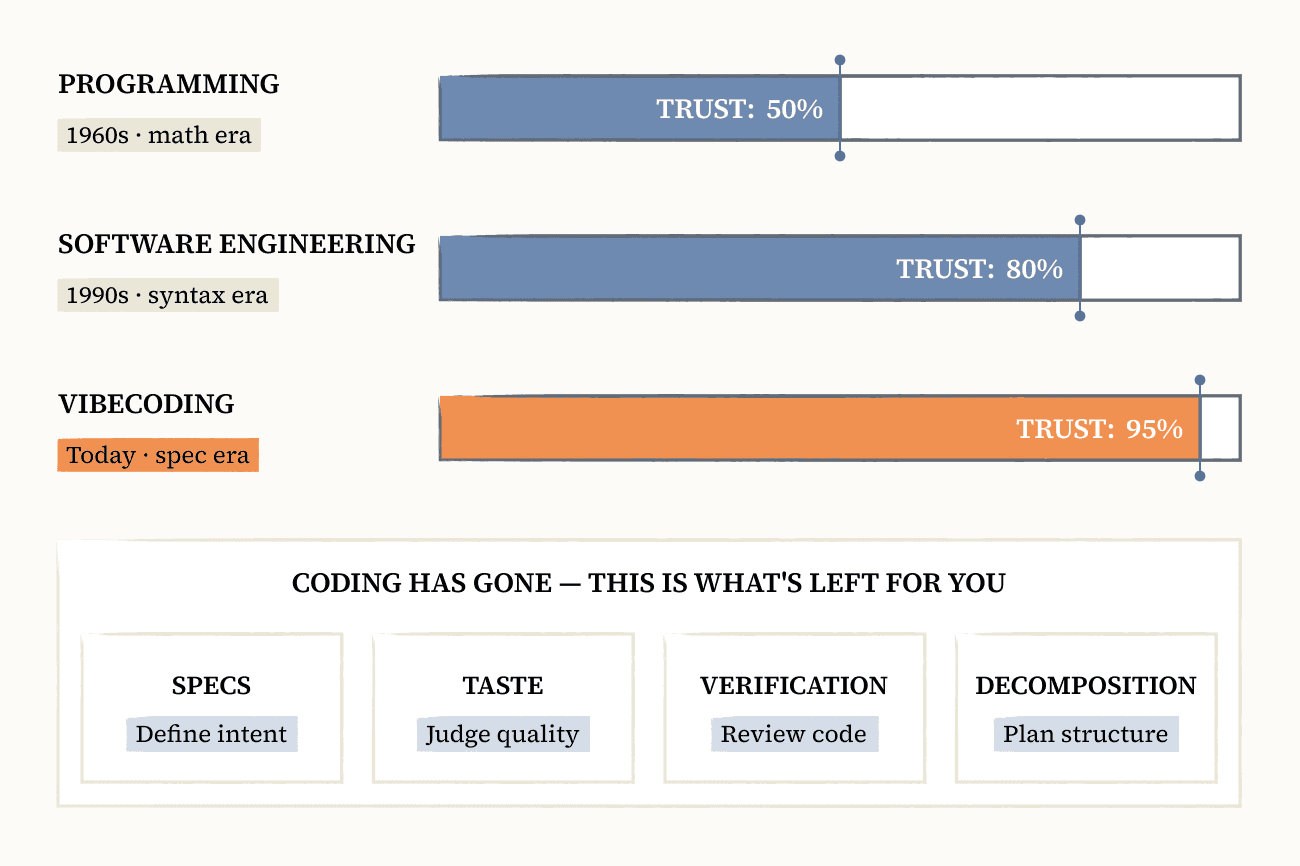
Four this required to run at 95% trust
Specs — knowing what you actually want, in language precise enough that the machine can hit it. Most people are bad at this because we've spent careers describing the how and forgot how to articulate the what.
Taste — knowing what good looks like when you see it. Managers without taste get steamrolled by their team, and vibecoders without taste ship garbage they can't recognize as garbage. We all see hundreds of websites shipped weekly that are different, yet exactly the same.
Verification — reading and judging code you didn't write. The code-review muscle, promoted from auxiliary skill to primary one.
Decomposition — breaking the problem into spec-sized chunks, which is just architecture by another name. This doesn't go away with vibecoding, it gets more important, because you're no longer hand-coding the glue that used to hide your bad decomposition.
One asymmetry to keep in mind: humans push back, AI complies, so calibration of trust comes from you and not from the system kicking back at you — verify harder, not less, and treat your agents like junior reports, not seniors.
The 80% holdout doesn't get fired, they just get slower — their tickets take longer, the team starts routing work around them, and six months later when the budget tightens you can guess who goes first.
We've been vibecoding since 1995. The dial just turned up.
Next piece will be the spec patterns themselves — what to put in, what to leave out, how to structure intent so the machine actually hits it. This is currently my homework, and I've made an Atlas to track it, released as a public live doc so you can follow along.
Stay safe. Learn and grow with us. Thanks.
Wolf Alexanyan, Armenia, May 2026.